Abstract
The article analyses the accounts of two seventeenth-century travellers, Evliya Çelebi and Adam Olearius, on the North-East Caucasus and on the feudal elite, administrative order, and customs of the region. A wide range of factual material is brought together, source quotations are introduced, and a detailed comparative analysis is offered. The authors draw attention to the differences in the two travellers' assessments of what they saw, and investigate why these differences arise. In their view, the travellers' perceptions were shaped by the events of their own age and by religious ideas about people of the same or a different faith.
Keywords: Evliya Çelebi, Adam Olearius, North-East Caucasus, Dagestan, shamkhal, Tarki, Derbent, padishah, feudal lords, religion of the Turks, the German, worldview, traditions.
The two travellers
Evliya Çelebi and Adam Olearius are two remarkable contemporaries, travellers, and researchers. It is doubtful that they had even heard of one another. Their lives, religious convictions, and outlooks were different, and different too were the circumstances that brought each of them to Dagestan. None of this could fail to mark their perception of what they saw. We shall therefore say a few words about the travellers themselves and about the reasons for their journeys.
Evliya Çelebi was born in Istanbul in 1611, in the family of a court jeweller and a sister of the Grand Vizier Melek Ahmed Pasha; he died in 1682. He is a product of the high point of Ottoman culture and learning, a contemporary of the polymath Hüseyin Hezarfen, of the inventor Hezârfen Ahmed Çelebi (nicknamed the "Turkish Icarus" for having flown across the Bosphorus on wings of his own making in 1632), and of the historians İbrahim Peçevi and Kâtib Çelebi. Gripped by a great interest in geography, ethnography, and zoology, Evliya Çelebi travelled through a great many countries, visiting Dagestan twice. The first time, in 1641–1642, he visited and described Derbent and certain districts of Southern Dagestan; the second time, in 1666–1667, accompanying the deposed Crimean khan Mehmed Giray, he toured Kumykia, visited Kaitag, Tabasaran, and Derbent, and then, after a sea voyage across the Caspian, landed near the Russian fortress of Terki. It is this last journey that produced the notes which form the basis of our study.
Adam Ölschläger (Olearius, or more precisely Olearius — the Latinized form of his real surname) was twelve years older than Çelebi. The son of a tailor from an impoverished family, by force of his own energy and curiosity he received a higher education and developed into a universal figure combining the talents of historian, linguist, mathematician, geographer, physicist, and engineer. He died in 1671.
Duke Frederick III of Holstein, in whose service Olearius was employed, was an ally of Denmark, Spain, and Austria in their struggle against the Franco-Swedish-Dutch alliance. In the opinion of Fyodor Soimonov, an associate of Peter I and an explorer of the Caspian coast, the chief motivating aim of the Holstein embassy to Persia was precisely to damage the Dutch economy by breaking its monopoly on trade with Persia. Even before the expedition set out, a Persian trading company was founded in Hamburg under the aegis of the Duke of Holstein, its leading figure being Otto Brüggemann. The latter, together with the diplomat Philipp Crusius (great-grandfather of the Russian admiral Ivan Krusenstern), was appointed head of the Holstein embassy to Persia, with Olearius as their secretary and interpreter.
Brüggemann's ship was of a construction entirely unknown on the Caspian. It was built in Nizhny Novgorod under the direction of a Holstein "shipwright." It was 120 feet long, seven feet deep, with three masts and twenty-four oars; it ran aground at Nizabad [8, pp. 322–323]. From there the travellers had to continue along the shore.
The company's hopes of extraordinary profits were not borne out. The Holstein merchants realised that even if they bought Persian silk at half price, they would not be able to recover the cost of transporting it along the Volga and around the Scandinavian peninsula. By way of consolation, Shah Safi gave Brüggemann, Olearius, and the other luckless negotiators funds for the return journey [8, pp. 322–323].
Despite the Persian failure, the Holsteiners left a significant mark on the history of the North-East Caucasus. One of the most curious facts is the commercial negotiations that took place in the town of Endirey on 15–17 May 1638 between the shamkhal Aydemir, son of Sultan-Mahmud, on one side, and Philipp Crusius and Otto Brüggemann on the other. The treaty was drawn up by Adam Olearius. So far as is known, this is the only official agreement of its kind in history between a Western European and a North Caucasian state [6, p. 511]. Brüggemann promised the shamkhal that the Holstein merchants would visit Endirey every year, but his words remained mere promises.
Evliya Çelebi's Dagestan
Çelebi calls Dagestan "the state of the high-born shamkhals" (Al-i Shamhaliyan Devleti) [1, p. 117]. "It is pointless to contend with, and prevail over, the shah of Dagestan." He puts the strength of Shamkhal Surkhay's army at 87,000 men. "The Dagestan land is surrounded on all sides by the [possessions of] rulers of seven padishahates, seven khanates, and seven provinces; and they wage war day and night against the rulers of every country, and they are brave young men who beat back all enemies" [10, p. 108].
The Turkish traveller maintains that "the Dagestan country" comprises seven khanates, forty-seven qadiyates, forty-one towns, and fifty-six fortresses [10, pp. 107, 115]. Demir-Kapu (Derbent), in his view, has seven mortal enemies, first among which he places the Cossacks [9, p. 174].
Çelebi's impulse to divide every country into seven provinces, to surround it with seven neighbouring states, to mention seven enemies and the like, is readily apparent. The number seven plays no small role in Muslim tradition (the seven heavens of Paradise, the Seven Sleepers of Ephesus, the seven climes of the inhabited earth — the oecumene, and so on); there is therefore no reason to take Çelebi's figures literally. Speaking of trade, Çelebi reports that in Dagestan kurush and "altyns" are not used, and barter prevails; the local "…merchants never travel to Iran. But they trade with the infidel Muscovites" [10, p. 107].
Çelebi sets the boundary between the Iranian and Dagestani padishahs' domains at the city of Demir-Kapu (Derbent) [10, p. 108]. Scholars still pay too little attention to the fact that Olearius distinguishes the "Syriac" inscriptions in the graveyard from the Arabic ones [2, p. 110]. It is well known that before the Arabisation of Syria the Aramaic script was in use there.
Evliya Çelebi also speaks separately of the shamkhal's councillors: "The vizier of the shamkhal-shah is Taqi-Khan. The said khan knows the Qur'an by heart; he is old and pious. After him come: the khan — ruler of the country of Karabudakh; Ulu-Bey, Ali-Bey, Kasym-Bey, Kazanal-Bey, Mukhammed-Bey, Ilkas-Bey, Livardi-Bey, Khaidar-Bey, Khalil-Bey, Choban-Bey, and there are many other beys besides. To them belongs the power. No reception passes without the appearance of the shamkhal-sultan. They call this 'appearing at the khans' assembly.' In it are represented all the khans — rulers of the country. It is this assembly that announces the establishment of any charitable institution for the poor of the city of Tarki."
In his telling, the rulers reject luxury and vanity, take care of their subjects — Muslims and non-Muslims alike. The law here is in the hands of the Muslim theologians [10, p. 106]. "Silk is entirely absent from their dress, for being men of temperance they do not wear silk at all, following the hadith: 'He who dresses in finery in this world shall not be clothed in the next'" [10, p. 106]. Çelebi, clearly idealising his subject, asserts that deceit, treachery, and envy are unknown in this country. He considered Dagestan a cultured land for its time.
Olearius's Dagestan
Adam Olearius describes what he saw quite differently. Having noted that Imam-Murza, son of the previous shamkhal Eldar, fears being poisoned by his cousin Surkhay, he quotes from the Bible: "Thy princes are companions of thieves" (Isaiah I). The verse in full reads: "How is the faithful city become an harlot! it was full of judgment; righteousness lodged in it; but now murderers. Thy silver is become dross, thy wine mixed with water: thy princes are rebellious, and companions of thieves: every one loveth gifts, and followeth after rewards: they judge not the fatherless, neither doth the cause of the widow come unto them." Under such circumstances, any "charitable institutions for the poor of the city" were out of the question.
In turn, the same Surkhay characterised Sultan-Mahmud (in this case his son, the shamkhal Aydemir) as a bandit to whom bloodshed gives the sole pleasure [6, p. 505].
And yet even the Holstein diplomat could not conceal his admiration for the love of freedom shown by a Kumyk prince — the brother of the future shamkhal Surkhay — designating him by the title Murza, though tinging the passage with irony. He describes a striking episode that took place in 1636 in the Russian fortress of Terki: the Murza, who was in the fortress at the time, refused to stand and drink to the health of the Grand Prince of Moscow. When the Terek service prince Mutsal Cherkassky asked, "Does he not know in whose land he now is?" the Murza boldly replied that he still doubted whether he was in the land of the Grand Prince or in his own…. "For Terki, and this whole region, until quite recently belonged to the Tatars (that is, the Kumyks. — Yu.I., M.-P.A.)," and added on his own account that "…though Mutsal goes about in fine robes, yet he is nothing other than a slave of the Grand Prince; he himself, in his simple robes, is a free prince, subject to no one but God" [6, p. 428].
In another place Adam Olearius gives a vivid example of the high value placed on their own independence by the Buynak subjects of the shamkhal, who declared that they had no concern either for the Persian shah or for the Grand Prince of Moscow, and that they were subjects of no one but Allah [6, p. 496].
Geography, rulers, and customs
Besides Tarki and Demir-Kapu, Çelebi also describes such feudal domains as Endirey, Kaitag, Tabasaran, Kubachi (Kyubechli in the source), and Tsudakhar (Sudakher in the source). Speaking of Kaitag, the Turkish traveller mistakenly called the local inhabitants descendants of the Mongols [10, p. 160]; but if one takes into account that the Dutchman Jan Janszoon Struys, who visited Kaitag five years later, recorded a detachment of "Kalmyk Tatars" in the service of the Kaitag usmi [2, p. 138], one may suppose that it was precisely these "Mongols" that Evliya Çelebi met.
A striking coincidence: both authors mistakenly name the ruler of the principality of Endirey "the shamkhal Sultan-Mahmud," that is, they identify him with the figure well known in the North Caucasian region from the late sixteenth to the first half of the seventeenth century — Sultan-Mahmud (Soltan-Mut, in local tradition) — who was never in fact a shamkhal. Olearius was in fact received by his elder son, the shamkhal Aydemir, and Evliya Çelebi by his younger son, Kazan-Alp. Both authors give a great deal of attention to the geography of the region, comparing its features with realities familiar to their readers from home. Olearius, for instance, compares the Koysu river (Sulak) with the Elbe and reports its depth as more than three human heights [6, p. 508].
Both authors equally stress the supreme authority of the shamkhal of Tarki over the other Dagestani feudal lords. Evliya Çelebi styles the shamkhal shamkhal-shah, shamkhal-sultan, padishah, and even shahanshah of Dagestan; the German traveller for his part characterised the shamkhal as the king among the rulers of Dagestan [6, p. 485]. He renders the title shamkhal (in Kumyk transcription: shawkhal) as "the Light" (Lumen) [6, p. 495].
Both the German and the Turk devote considerable attention to the capital of the Shamkhalate — the town of Tarki. "From of old Tarki has been the seat of the shahanshah of Dagestan," writes Çelebi, who even gave the town the chapter-headings "On the qualities of the great city of Tarki" and "In praise of the city of Tarki" [10, pp. 105–106]. It is also thanks to the Holstein author that a unique engraving of the city itself has come down to us.
Both the Turk and the German took a particular interest in the Caspian Sea. Çelebi provides curious information on the sea's names: "By the name of each country, this sea is called the Shirvan Sea and the Demir-Kapu Sea, the Gilan and Khwarezm Faghfur Sea, the sea of the country of Kizlyar, the Moscow and Astrakhan Sea, the Sea of the Iron Gates and the Alatyr Sea, the Terek Sea…. But in this region they call it the Sea of Dagestan and the Sea of Shirvan" [10, p. 107].
Olearius, having briefly described the countries around the Caspian, concludes that it may rightly be called a "Mediterranean sea," since, as Herodotus wrote, "the Caspian Sea is by itself, and has no communication with the others" [6, p. 442].
Çelebi arrives at the same conclusion, pointing to the impossibility of any connection between the Caspian — or, as he puts it, the Khazar Sea — and the Black Sea via the river Fasho (Phasis) in Georgia, on the ground that the water of the Fasho is sweet, whereas "the water of the Khazar Sea is worse than deadly poison" [9, p. 172].
Both authors resort to hyperbolic assertions and comparisons when describing local customs, inclining to the "exotic" and seeking to strike their readers. The Turk, for instance, claims: "Quite young boys grow beards at the age of ten" [10, p. 110].
The German, in turn, describes a strange custom unknown among the Kumyks which took place, by his account, at Endirey in the first half of the seventeenth century. At weddings, guests would bring an arrow, which was shot into the ceiling and left in that position until it had rotted away [6, p. 509].
In both works note is taken of the role of the mausoleum (ziyarat) on the mountain near Derbent, the shrine of the legendary hero of the Turkic epic Dede Korkut (Imam Korkhud in Olearius) in the religious life of the Azerbaijanis [10, p. 176].
It is noteworthy that both travellers mentioned such a small Dagestani polity as Tsakhur. Olearius — in connection with the fact that a kidnapped soldier from his escort, the Scotsman William Goy, was taken there [6, p. 506]; Çelebi, who had himself been at Tsakhur, points to the warlike character of its inhabitants [9, p. 178].
Companions of Olearius
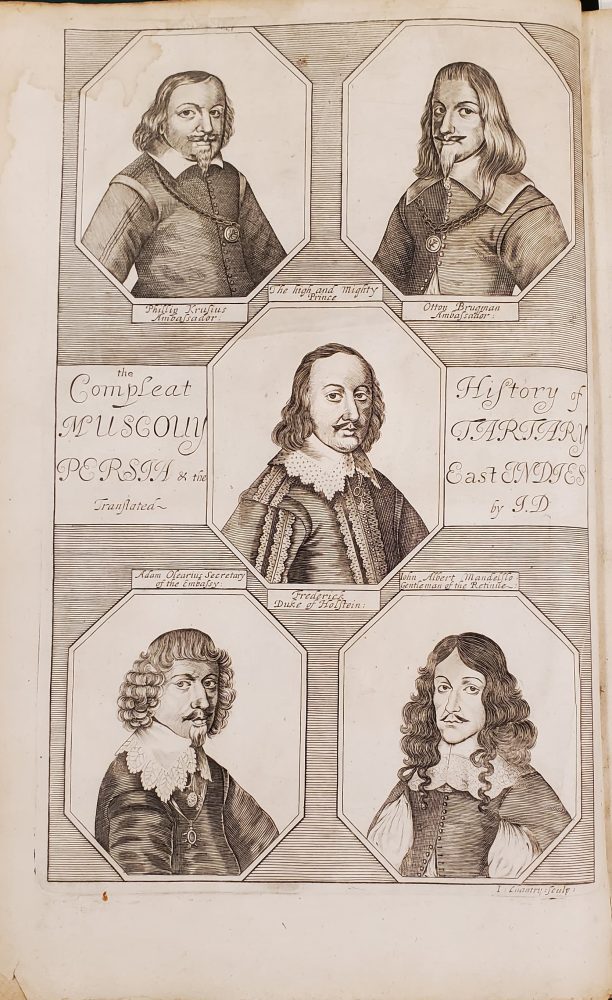
Adam Olearius was accompanied by the foremost German poet of his time, Paul Fleming. He too left a description of what he had seen, but in verse. His poems are included in Olearius's own book. Fleming too had his say about the Dagestani feudal lords, and especially about the shamkhal, remarking on his awesome presence, as well as on the ardour and wildness of his subjects [3, p. 85].
Another celebrated companion of Olearius, Johann Albrecht von Mandelslo, visited Dagestan only while passing on to Persia, whence he travelled on to India, and likewise left accounts of his travels which, unfortunately, have still not been published in Russian.
Seven reasons for the differences
Among the circumstances that brought about the divergence of the two travellers' descriptions, we believe seven should be singled out:
- Differences in the travellers' own characters and in the reasons for their second visits to Dagestan. Olearius and his companions returned to Dagestan after a fiasco at the court of Shah Safi, which was an additional irritant in their perception of the surroundings.
- The religious factor. In the view of the seventeenth-century Dagestanis, Olearius and his companions were outsiders, kafirs, who had not yet submitted to Muslim authority and whom it was therefore "no sin" if not to kill, then at least to rob. The local inhabitants, in the Holsteiners' view, were likewise outsiders, "unbelievers," barbarians. Hence the mutual hostility and alienation a priori. It should also be remembered that Holstein in the Thirty Years' War was allied with the two chief enemies of the Ottoman Empire — Spain and Austria — which were vigorously conducting an anti-Muslim propaganda war in Europe in order to distract public opinion from the ideas of the Reformation [4, p. 117]. War is least conducive to an objective viewpoint. Moreover, the attire and etiquette of the Europeans and Caucasians differed. It was another matter with honoured guests, Sunni Muslims: Khan Mehmed Giray and Evliya Çelebi. "The Dagestani padishah, the shamkhal-shah Sultan-Mahmud, sent such gifts, foods, and drink, and so much respect and every possible honour was shown to the khan, that it is all beyond description by pen" — so the Turkish traveller sums up the courtesies paid to them [10, p. 104]. And the very understanding of etiquette among Muslims and Christians of that epoch was altogether different.
- The low status of the merchant Otto Brüggemann and the diplomat Philipp Crusius — representatives of a small and remote German principality — who by then no longer had even letters of credence and, more importantly, no costly gifts (these had perished with the ship) — and of their secretary and interpreter Olearius, as compared with Khan Mehmed Giray (albeit a fugitive) and the Ottoman sultan's courtier Çelebi, who carried letters of credence even from the Austrian emperor — something that astonished the voivode of Astrakhan at their meeting [9, p. 132].
- The Europeans' poor level of information about Dagestan compared with the knowledge of the Turks and other Middle Eastern peoples. It is telling that on a map drawn up in the Vatican at the end of the sixteenth century, Khazaria was still marked on the territory of Dagestan [7, p. 100].
- The factor of the language of communication. Although Olearius was competent in Eastern languages — he even compiled a German–Persian dictionary and translated the works of Sa'di into German — his knowledge of the Turkic languages is open to question; in any case, such knowledge as he may have had was of a bookish character and did not permit that living interaction with the local inhabitants which was available to Çelebi, and especially to his Crimean-Tatar and Nogai companions.
- The chronological gap in their visits to Dagestan. Olearius was in Dagestan in 1636–1638, at the very height of the confrontation between the shamkhal Aydemir and the ambitious and strong pretender to the shamkhal throne, Surkhay. Times of internecine strife have never anywhere been favourable to travellers. Evliya Çelebi, by contrast, arrived here during a period of political stabilisation, when Surkhay had succeeded in becoming the sole ruler-shamkhal and in extending his dynasty's power once again into the most remote mountain corners of Dagestan and Chechnya [5, p. 198].
- The socio-cultural stereotypes that had built up over the preceding centuries. Immanent conceptions triumphed over objectivity, and both travellers, each in his own way, described what they saw in the way their countrymen-readers would wish to see it. By the seventeenth century, traditions of travel writing had already taken shape in both West and East, and to offer a reader an objective picture was still too risky a step. The least penalty for the author of such a work would be the absence of any readership.
Conclusion
The existence of two such unique sources on the history of Dagestan as Adam Olearius's Description of a Journey to Muscovy and through Muscovy to Persia and Back and Evliya Çelebi's Book of Travels, and their comparative analysis, have extraordinary importance for an understanding of the full and objective picture of the political history, customs, and economic life of the region in the seventeenth century and of their further development in what followed. Both works therefore still hold great potential for present-day scholars. The vivid descriptions of the authors, not dimming three and a half centuries on, the subtlety of their observations, their wide erudition, the emotional assessments and comparisons they employ, and the striking impression they produce, remain a reliable guarantee of the continuing relevance of their works.
Footnotes
- Aliev K.M. Kumyki i ikh praviteli Shaukhaly v osmanskikh (turetskikh) istochnikakh XVI – pervoy poloviny XVIII vv. [The Kumyks and their Shaukhal rulers in Ottoman (Turkish) sources of the 16th – first half of the 18th century] // Srednevekovye tyurko-tatarskie gosudarstva. Kazan: Ikhlas Publishing House, 2010. Issue 2. Pp. 115–122. (In Russian)
- Gadzhiev V.G. Dagestan v izvestiyakh russkikh i zapadnoevropeyskikh avtorov XIII–XVIII vv. [Dagestan in the accounts of Russian and Western European authors, 13th–18th centuries] / Comp. V.G. Gadzhiev. Makhachkala: Dagknigoizdat, 1992. 301 p. (In Russian)
- Gamidov A. Dagestanskie stikhi nemetskogo avtora [Dagestani poems by a German author]. Makhachkala: Respublikanskaya gazetno-zhurnalnaya tipografiya, 2007. 111 p. (In Russian)
- Lazareva A.V. Obraz vraga i stanovlenie nemetskoy natsionalnoy idei v gody Tridtsatiletney voyny (1618–1648 gg.) [The image of the enemy and the formation of the German national idea during the Thirty Years' War (1618–1648)] // Voprosy istorii. 2013. No. 2. Pp. 110–123. (In Russian)
- Magomedov R.M. Istoriya Dagestana [History of Dagestan]. Makhachkala: Dagknigoizdat, 1998. 208 p. (In Russian)
- Olearius A. Opisanie puteshestviya v Moskoviyu i cherez Moskoviyu v Persiyu i obratno [Description of a journey to Muscovy and through Muscovy to Persia and back]. St Petersburg: A.S. Suvorin Press, 1906. 582 p. (In Russian translation)
- Polyak A.N. Vostochnaya Evropa IX–X vv. [Eastern Europe, 9th–10th centuries] // Slavyane i ikh sosedi. Issue 10: Slavyane i kochevoy mir. K 75-letiyu akademika G.G. Litavrina. Moscow: Nauka, 2001. Pp. 79–101. (In Russian)
- Soimonov F. Opisanie Kaspiyskogo morya i chinenykh na onom rossiyskikh zavoevaniy, yako chast istorii Gosudarya imperatora Petra Velikogo [A description of the Caspian Sea and of the Russian conquests made upon it, as part of the history of the Sovereign Emperor Peter the Great] // Ezhemesyachnye sochineniya i izvestiya ob uchyonykh delakh. St Petersburg: Imperial Academy of Sciences Press, 1763. 380 p. (In Russian)
- Çelebi E. Kniga puteshestviy. Vyp. 3: Zemli Zakavkazya i sopredelnykh oblastey Maloy Azii i Irana [Book of Travels, vol. 3: The lands of Transcaucasia and the adjacent regions of Asia Minor and Iran]. Moscow: Glavnaya redaktsiya vostochnoy literatury, 1983. 376 p. (In Russian translation)
- Çelebi E. Kniga puteshestviy. Vyp. 2: Zemli Severnogo Kavkaza, Povolzhya i Podonya [Book of Travels, vol. 2: The lands of the North Caucasus, the Volga, and the Don regions]. Moscow: Glavnaya redaktsiya vostochnoy literatury, 1979. 287 p. (In Russian translation)