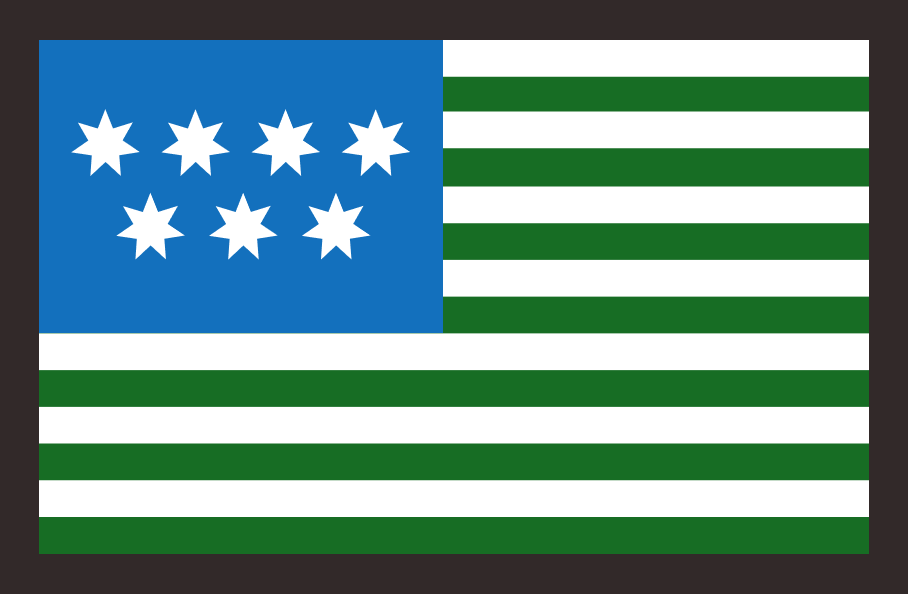
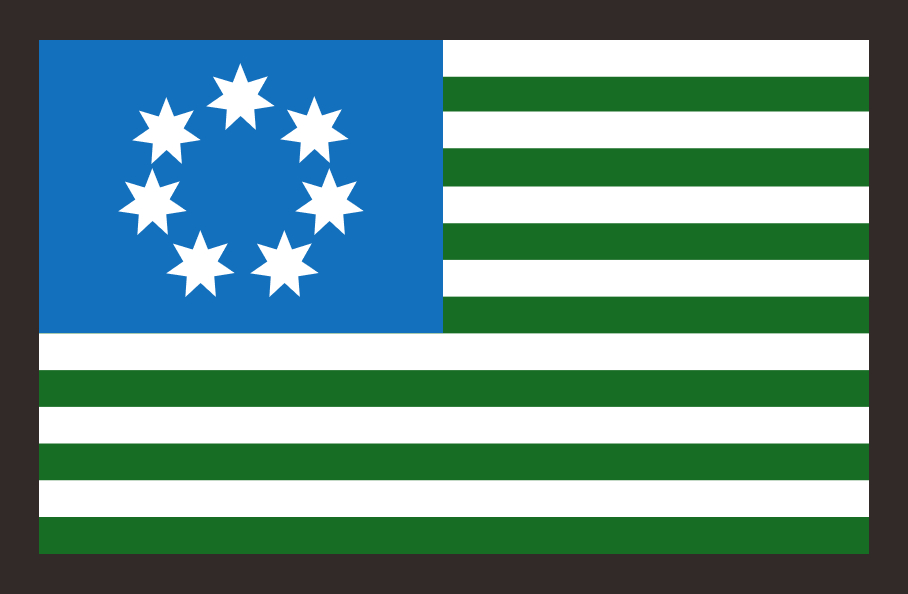
kumykia.com is the first site to publish a precise reconstruction of the flag of the Republic of the Union of Peoples of the North Caucasus based on A. Uzhakhov's 1920 article.
While the mountaineers wage a titanic struggle for the independence of their Republic against the black reaction of the Volunteer Army, and while the leaders of the highland movement for that independence, Ali-Hajji and Uzun-Hajji, have received from the centre of the Communist government red banners embroidered in gold with a crescent and star, I think it will not be amiss to say a few words about the national flag of the Mountain Republic.
Anyone who ever visited, before the revolution, the "Temple of Glory" in Tiflis — where all the trophies of the Caucasus War were gathered — could not fail to notice the banners of Imam Shamil and his naibs. All those banners and pennants were either white or green, with verses from the Qur'an embroidered on them, but without any image of a crescent or star; on some of them only the tip of the staff ended in a crescent.
In 1918 the first Mountain Government of T. Chermoev waged its struggle against the various reactionary groups hostile to the independence of the highlanders under a national flag designed by an initiative group of the highland intelligentsia. It was under this flag that the highland forces fought when, in that same year of 1918, they took the cities of Derbent, Petrovsk and Temir-Khan-Shura. From that time on this flag flew over the whole territory of the highlands, down to the betrayal by the Khastagov government and its associates.
The flag is of the following description: seven white horizontal stripes alternate with seven green horizontal stripes from top to bottom; in the upper corner of the cloth, at the staff, on a single light-blue rectangular field, are placed seven white, seven-pointed stars, as the emblem of the seven principal nationalities that make up the Republic. The light-blue colour was included in the flag in order to distinguish the flag of our Republic from those of the German states of Anhalt and Saxony, whose national flags are of white and green.
In designing the flag the initiative group was guided, among other things, by the following circumstance. As we know from history, when the prophet Muhammad, during his flight from Mecca to Medina, entered the latter city, and as he made his solemn entry into it, one enraptured ansar unwound his white turban and tied it to the end of his spear, while one of the muhajirun likewise unwound his green turban and attached it to another spear, and they carried them aloft as banners. Following these first two Muslim banners, Medina accompanied its great teacher with the unanimous singing of dhikr in praise of Allah.
By way of illustration I cite here the national flags of the principal Muslim states: the national flag of Turkey, the Caliphate of the whole Muslim world — red and white; of Egypt — red and white; of Morocco — green and yellow; of Tripoli — red; of Tunis — yellow and green; and of Persia — green, yellow and white.
The question I have touched upon — the national flag of the Mountain Republic — is, in my opinion, a perfectly timely one. I have not sought to settle the question of the national flag definitively; my aim will be achieved if the highland intelligentsia takes up the study of this question, so that, when the final decision is made, the Council of Defence of the North Caucasus, which at present carries out the functions of the Mountain Government, may make use of these labours.
A. Uzhakhov. Volny Gorets, No. 35, 22 March 1920, p. 3.