The Caspian, no less than the Mediterranean itself, has a right to the name "inland sea". Though it is surrounded on all sides by land, it is a sea of fierce temper. Violent storms are ordinary here and for centuries they took many and many lives. Persian geographers as late as the tenth century placed in its northern reaches an enormous whirlpool called the Lion's Mouth, said to suck into its insatiable maw every ship that strayed off course.
The port towns, the fishing villages and the other forms of human settlement along the Caspian shore made up a single whole — a Pax Kaspiana, a Caspian world. A worthy place in its history was held, for centuries, by our ancestors — the Kumyks.
The history of seafaring on the territory of the Kumyk Plain reaches into remote antiquity, to a time before any of the modern peoples existed. Naturally, there were no Kumyks then either; but the traditions of fishing laid down in that age passed, through successive ancestral peoples, into their inheritance. So to the third millennium BC belongs a large settlement that once stood on the southern edge of present-day Makhachkala, on a low rise east of the Fifth Settlement (Pyatyi Posyolok). Judging by the finds — stone weights for marine nets — its inhabitants were closely tied to fishing.
Seafaring along the Kumyk coast scarcely ever ceased. Yet anything more or less substantial about the local mariners and their craft appears only at the close of the Middle Ages. The Venetian Ambrogio Contarini remarked on the boldness of the local seafarers, given the primitive construction of the vessels he called "boats" (boti).
The Tarki anchorage suffered from shallow water and a sandy bottom that gave no hold for an anchor. Even so it remained in use; a brisk trade with Astrakhan was carried on there. Further south, from Tarki all the way to Derbent, there was scarcely a convenient harbour. The single exception was the mouth of the Boinak River, up which, the sources say, ships could even sail.
Vessels went up the Koysu as far as the stockade fort that stood upon it. The Koysu stockade lay some fifteen versts north of Tarki.
In the early seventeenth century a landing-place also operated at the Aksay koltuk — the mouth of one of the Terek's branches, which emptied into Agrakhan Bay.
Fyodor Kotov wrote in 1623: "And opposite the Terek is Chechen Island, which stands in the sea; under sail it is half a day's passage to it, and the island is large and has much fish. And on that island the Terek people and the Tarki Kumyks (!) and the highland Circassians fish."
To form even an approximate picture of seventeenth-century Kumyk vessels, let us quote a description of the Gilan and Shirvan ships that plied the Caspian at the same period: "They have exactly the form of a fish and bear that very name, for they are narrow at stern and bow and very bulging at the sides … for steering they have two masts and a great pole which serves them in place of a rudder … in foul weather they resort to sails; sometimes they also use oars."
The Kumyk fleet was an active ally of the Qizilbash (Persian) fleet in the fight against Stepan Razin in the summer of 1669 (see M. N. Tikhomirov, The Russian People's Struggle for an Outlet to the Sea). Razin faced fifty ships of the combined Persian–Kumyk fleet, with cannon and soldiers aboard.
At the close of Shamkhal Buday's reign, however, joint Kumyk–Cossack piracy took wide scope on the Caspian. In September 1691, "five hundred Cossacks and a hundred Tatars and Kumyks of the shevkal's realm" under the ataman Senka Khmury engaged on the Caspian a convoy of the tsar's ships (Yavuz Akhmadov, "The Russian Insurgent Movement of the Late 17th and Early 18th Centuries and the Peoples of Daghestan", in Daghestan in the Russian State, Makhachkala, 1990, p. 82).
Russian sources describe 17th-century Kumyk vessels as strugi.
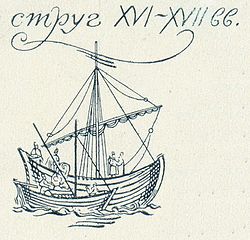
Strugs were in essence the same "boats" that Contarini had mentioned two centuries earlier. Thanks to their flat bottom, they could approach the Tarki anchorage.
As Ye. I. Inozemtseva writes: "From Russia, Tarki and the routes through it supplied inland Daghestan chiefly with metal goods: copper cauldrons (green and red copper), iron-bound chests, axes, knives, nails, needles, pins, scissors, and so on; furs and articles made from them; European woollen cloth. From Tarki, and through Tarki, Russia received craft goods — kilims, carpets, sabres, daggers — along with agricultural produce, and, above all, raw cotton, raw silk and madder. Oriental goods travelled the same road to the Russian market: costly fabrics, precious stones, silk, some of which went on in transit to Europe."
Not infrequently the men of Tarki carried freight to Astrakhan themselves. For instance, according to the Astrakhan customs record, on 11 August 1672 "the Tarki man Allaberdeyka Aleyev departed Astrakhan for Tarki in his strug, with seven workmen in his company; and his cargo was one hundred pieces of red yuft leather, twenty-five green-copper cauldrons, and two boxes with a hundred merlushki [astrakhan lambskins] inside …".
Besides trading by sea, fishing had long flourished among the Kumyks. Favourable conditions — proximity to the sea, a wealth of full-flowing rivers — made fishing natural to them. Adam Olearius, a seventeenth-century author, describing a reception given by Surkhai, the shamkhal of Tarki, mentions beluga among the dishes; having visited Endirey, he reports that "the people here are for the most part fishermen, and were often … on the river, for it is rich in fish, and they would catch great numbers of sturgeon and fish of the sturgeon kind". Describing a dinner with the ruler of Endirey, Olearius singles out the principal dish — "a great cauldron of sturgeon, cut and torn into small pieces and boiled in salt" (cited from: Ye. I. Inozemtseva, "On the History of Maritime Economic Activity of the Peoples of Daghestan", Bulletin of the Institute of History, Archaeology and Ethnography, 2005, no. 4, pp. 12–23).
According to J. A. Güldenstädt (18th century), the Kumyks "make more use of fishing than do the other Tatars, and by catching sturgeon and other fish lighten their means of subsistence".
Seafaring realities entered deeply into Kumyk folklore, and into the language itself: in a distinct nautical and fishing vocabulary, in legends, songs and folktales.
At the beginning of the eighteenth century Adil-Geray asked Peter the Great for two ships: "for my need of them is no small one". We have no direct evidence whether the shamkhal received them; but the podskarbii Yakov Markovich, in an inventory of Kumyk property at Tarki destroyed in 1725 by a punitive detachment under General Kropotov, mentions 2 ships, 5 boats and ships' cannonballs (Notes of the Little Russian Podskarbii Markovich, p. 141). This, in all likelihood, was no longer a matter of the strugs-boats familiar to the men of Tarki, but of real ships of greater tonnage, since to obtain them one had to apply to the tsar himself.
The dominance on the Caspian in the eighteenth century of the Russian fleet, armed with the latest cannon, brought piracy to an end. The Kumyks turned to trade and fishing, and made up the largest share of Daghestani fishermen until the first half of the twentieth century. Witnesses report that the Kumyks would sail a considerable distance from shore in their small boats — kayuks. And although the great ships and the naval engagements were already a thing of the past, the spirit and the inheritance of many generations of bold seafarers carried them through their hard and dangerous trade.
A detailed history of Kumyk seafaring has yet to be written; this sketch is only a brief and approximate chart of distant, little-known shores of the past, of which we know so far only by scattered notices.